
Learning to Problem-Solve through Junk Play
21 August 2026

If you have ever seen young children more excited about the box or wrapping paper than in the gifts themselves on Christmas morning then you may have caught a glimpse of just how much joy simple items such as boxes, paper or packaging can bring to a child!
But what if these ‘junk’ items could be seen as more than just items destined for the rubbish or recycling bins and instead be seen as powerful (and often free) tools for helping your child learn?
In the world of early childhood education the term for this type of play is junk play and and it is widely recognised for the benefits it offers to children’s learning and development.
Here are just a few of these!
Creativity and Imagination skills
It almost goes without saying that your child’s creativity and imagination skills are given a good work out when they play with junk objects! Because junk is not prescriptive (made to be used in one singular way), there are no rules as to how it has to be viewed or used.
This means children need to first see the object, then think creatively around an idea for it before bringing it to life with their imaginations.
In a world where screens are taking over children’s play, junk play offers a simple way to let your child’s creativity thrive!
As a well known child educator by the name of Magda Gerber was fond of reminding people that the more active a toy is (think screens or ‘educational’ toys that flash and make noises), the more passive a child becomes. On the flip side, the more passive a toy or an object is, the more active a child becomes.
Critical thinking skills
When your child is engaging in junk play they are being offered new and exciting opportunities to experiment and test out new ideas and theories!
Experimentation is a powerful way for your child to develop problem solving skills as they navigate which ideas work and which ones need a little refining. This process is invaluable for developing critical thinking skills!
If your child asks you how to do something it can sometimes seem easier to jump in and fix the issue, especially when you can see that they are becoming frustrated by a task.
Using ‘I wonder’ questions such as ‘Hmmm... I wonder why your tower keeps falling over?... I wonder what you could do to help make it more stable?’ can be a fantastic way to let your child know that you hear them, while also encouraging them to use their own creative problem solving skills.
Don’t forget that your child is learning just as much - if not more, through their ideas that haven’t worked out as planned.
Communication skills
As children test out new ideas and theories they are also given a fantastic way to be able to communicate these ideas with others!
You can further support your child’s communication skills by exploring new ideas and theories together.
A great way to start is by using open ended questions. These can encourage your child to communicate their ideas and knowledge and also allows an opportunity for you to role model thinking skills by demonstrating your thinking process out loud - being mindful of course not to solve all the problems!
Collaboration
If your child is engaging in junk play alongside others they are learning to communicate their ideas as well as collaborate with others to bring
these ideas to life! No two children think in identical ways so this collaboration can help introduce new ideas and ways to problem solve from others perspectives.
Learning is in the process not the product.
Your child’s junk play may not resemble anything at all and that is totally okay! Using junk materials to play and create with is developing skills all in itself! Using scissors, pens, tape or even just ripping up a box requires using hand muscles, hand eye coordination, spatial awareness and more! All of which will help support your child when they begin learning how to write.
What kind of junk items?
Here is a small list of ideas however safety is always important so please assess any objects for suitability in terms of your child’s age and developmental stage first. A basket of buttons may offer a four year old endless opportunities to create but could also offer toddlers a choking hazard.
Junk play should always be supervised.
Junk play item ideas:
- milk bottle tops, corks, jar lids
- sticks, stones, pinecones and shells
- cardboard boxes and tubes
- untreated wood offcuts
- food boxes, pottles
- yoghurt pottles
- fabric, blankets and scarves
- Egg cartons
- infant formula tins - check for sharp edges first. You can always glue the lids down for a safer option if you are unsure.
- tape (you can never have enough tape and a tape dispenser will be your best friend).
- paper grocery bags
- buttons
- PVA and/ore ‘cold’ glue guns
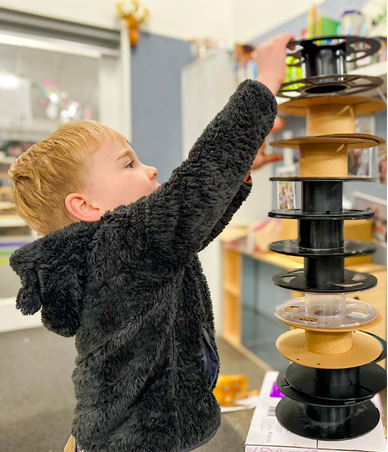
This is of course just a small list of ideas. The beauty of junk play is that children will have their own unique ways of using objects. If you really want to create some magic, visiting your local homeware store and asking if they have any spare large boxes can also open up a world of possibilities!
The Evolve Promise
At Evolve Education we believe that children are competent thinkers and problem solvers who actively seek, use and create knowledge!
That is why you will see junk play happening in our early learning centres too!
Your child’s centre may even ask for donations for their junk play collections. All the more reason to pause before throwing something away!
Learning starts with curiosity and this is why opportunities for children to engage in junk play really can help set them up as life long learners!
Next time you go to throw out that old cardboard roll, or flatten another box for the recycling bin, take a moment instead to consider the endless possibilities of fun, learning and creative problem solving it could offer your child first.
You just never know where your child’s imagination will take their learning next!

Pathways to School and Kura
Starting school or kura is a significant milestone for both children and parents. While many families focus on early academic skills, research and educators agree that confidence, curiosity, resilience, communication, and independence are the foundations of a successful transition. Discover how everyday play and simple home activities can help your child develop the lifelong learning skills they need to thrive at school and beyond.
Read more

Raising Creative and Innovative Problem Solvers
Young children are natural problem solvers, using creativity, curiosity and trial-and-error to explore the world around them. At Evolve Education, we intentionally nurture these skills through play-based learning, encouraging tamariki to think independently, embrace challenges and develop confidence, resilience and critical thinking. By supporting children to explore, experiment and discover their own solutions, we lay the foundation for lifelong learning in an ever-changing world.
Read more

Navigating Big Emotions
Big emotions are a normal part of childhood, but they can feel overwhelming for both children and the adults supporting them. In this article, we explore why children experience emotional outbursts, how brain development influences behaviour, and practical ways parents and caregivers can respond with calm, connection and confidence. From understanding "flipping the lid" to simple breathing games that help children regulate their emotions, you'll find supportive strategies to help your child navigate big feelings and build emotional resilience.
Read more
